
Beyond the Cheating Narrative: Understanding How Students Actually Use Generative AI
 Dr Salman Shahid is a Senior Lecturer (Teaching and Scholarship) in the Department of Chemical Engineering at the University of Manchester. He also serves as the Discipline Head of Education for Chemical Engineering. His work focuses on enhancing inclusive assessment, feedback, and student learning through the thoughtful integration of artificial intelligence both inside and outside the classroom. His current interests include AI-enabled feedback, assessment innovation, student partnership, and the development of evidence-informed approaches to Generative AI in higher education.
Shawn Walmsley, Antonis Theodorou and Ruoxi Wang are students in the Department of Chemical Engineering at the University of Manchester whose interests include the application of emerging technologies to support student learning, educational innovation, and the responsible integration of artificial intelligence in higher education.
The rapid adoption of Generative Artificial Intelligence (GenAI) has sparked intense debate across higher education. Discussions often focus on concerns around academic integrity, assessment security, and whether AI is making students less engaged in their learning. Yet one fundamental question remains surprisingly underexplored:
How are students actually using AI?
At the University of Manchester and across the sector, considerable effort has been devoted to understanding how AI may reshape teaching, learning and assessment. However, effective policy and curriculum design require evidence rather than assumptions. To contribute to this conversation, we worked with students to investigate how undergraduate and postgraduate students (n= 500) use GenAI in authentic academic settings.
This project was undertaken through a student-staff partnership (surveys, and focus groups) in Chemical Engineering, enabling us to move beyond speculation and develop a richer understanding of emerging student practices.
Students completed a declaration form identifying the AI tools they used and the specific tasks they performed during literature review and research project activities.
The findings challenge a common assumption that students primarily use AI to generate assignments with minimal effort. Instead, students appear to be using AI strategically to support learning, understanding and academic development.
Which AI tools are students using?
Students reported using a wide range of AI tools (Figure 1), with ChatGPT emerging as the most widely used platform.
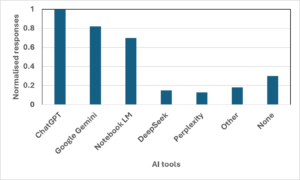
Figure 1. AI tools used by students.
Interestingly, most students did not rely on a single platform. Rather, they selected different tools depending on the task they wished to accomplish, suggesting the emergence of sophisticated AI literacy behaviours.
Learning support dominates student AI use
One of the most significant findings was the orientation of AI use.
Rather than using AI primarily for task completion, students reported using GenAI predominantly to support their learning.
Orientation of Student AI Use
Most students use AI to support learning rather than automate academic work.
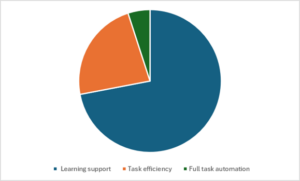
Figure 2. Orientation of student AI use.
This finding is particularly important because it suggests that students are using AI predominantly as a learning aid rather than as a replacement for academic effort
(Figure 2). In many respects, AI appears to be functioning as an extension of the learning environment rather than a mechanism for avoiding learning.
What are students doing with AI?
Students reported a wide range of uses for GenAI (Figure 3). These activities suggest that students are integrating AI throughout the learning process rather than simply using it at the point of submission.
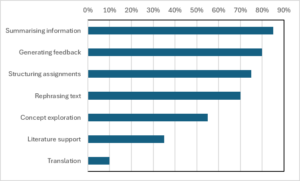
Figure 3. Tasks performed by students using AI
A particularly interesting observation was that many students viewed AI-generated information and traditional academic sources as complementary rather than competing resources. Students frequently used AI to interpret, explain and synthesise information obtained from scholarly literature.
How do students perceive the impact of AI?
Students were also asked about the impact of GenAI on their learning experience.
The results were overwhelmingly positive, particularly in relation to understanding and independent learning.
Student Perceptions of GenAI Impact
Percentage of students agreeing with statements about AI’s impact (Figure 4).
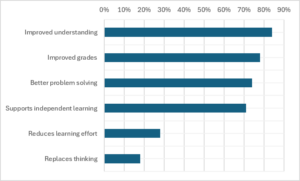
Figure 4.Impact of AI on student learning.
The findings reveal that:
- 84% reported improved understanding.
- 78% believed AI helped improve their grades.
- 74% felt AI enhanced their problem-solving abilities.
- 71% reported support for independent learning.
Equally important are the cautionary indicators:
- Only 28% believed AI reduces learning effort in a negative sense.
- Just 18% felt AI replaces thinking.
These findings challenge the widespread perception that students view AI as a substitute for intellectual engagement. Instead, students overwhelmingly position AI as a tool that enhances learning while maintaining the need for critical judgement and disciplinary understanding.
What does this mean for educators?
Across all datasets, a remarkably consistent picture emerges.
Students are:
- Active and strategic users of AI.
- Selective in their choice of tools.
- Primarily focused on learning enhancement rather than task replacement.
- Aware of both the opportunities and limitations of AI systems.
Perhaps the most important implication is that GenAI is increasingly functioning as a form of adaptive cognitive infrastructure within students’ study practices. Students are using it to obtain explanations, test ideas, receive feedback and support independent learning.
This suggests that the central question for educators is no longer:
“How do we stop students using AI?”
but rather:
“How do we help students use AI effectively, ethically and critically?”
The value of student co-creation
A major strength of this work was the involvement of students as partners throughout the project. As AI technologies continue to evolve rapidly, institutions cannot rely solely on staff perspectives to understand emerging practices. Students are often the earliest adopters of new tools and can provide valuable insights into how technologies are integrated into authentic learning workflows.
The contributions of student partners were instrumental in ensuring that the findings reflected genuine student experiences rather than institutional assumptions.
One student partner mentioned: “As students, we often feel that discussions about AI begin with the assumption that we use it to cheat. This project gave us the opportunity to show a more complete picture. The reality is that many students use AI to learn, receive feedback, improve understanding and study more independently.”
Where next?
Understanding how students use AI is only the first step.
The next challenge is designing learning experiences that harness AI’s educational potential while strengthening critical thinking, disciplinary expertise and academic integrity.
Concluding remarks
The findings of this study challenge simplified narratives surrounding the use of Generative AI in higher education. Rather than passively outsourcing academic work, students appear to be integrating AI into their learning practices in purposeful and constructive ways—supporting understanding, generating feedback, enhancing problem-solving, and enabling more independent study.
For universities, this represents not just a challenge, but a significant opportunity. By engaging students as partners, adopting evidence-informed approaches, and thoughtfully redesigning curricula for an AI-enabled future, institutions can move beyond narrow concerns about misuse. Instead, the focus can shift toward harnessing AI as a tool to meaningfully enhance learning.
Understanding how students use AI is an important starting point. The more pressing and transformative challenge lies in determining how we can support students to learn effectively with AI, fostering critical engagement, responsibility, and deeper learning outcomes.

TEA is a place where we can share practice and experience around teaching and learning with colleagues, students and the wider public – how we Teach, Explore, Apply
We’d really like to hear your responses to the stories we feature – if you want to respond, please email the ITL team at teaching.learning@manchester.ac.uk, or the University’s Teaching and Learning Online Network (TALON) on Yammer is a great place for you to carry on the discussion of any practice you find really interesting.


Contact Us
+44 (0) 161 306 6000


0 Comments