
Addressing Motherhood Bias in STEMM (Science, Technology, Engineering, Mathematics Medicine): Leading Inclusive Educational Practice Across the Pipeline
Samina Naseeb1 and Isabel Torres2
1 School of Biological Sciences, The University of Manchester, UK
2 Mothers in Science, Montpellier, France
 Samina Naseeb is a teaching-focused lecturer passionate about creating inclusive educational environments that inspire young people to pursue STEMM. She recently led a widening participation project in collaboration with Mothers in Science, designed to raise awareness of the motherhood penalty and encourage students to think critically about gender stereotypes, career aspirations, and progression within STEMM. Funded by the Faculty of Biology, Medicine and Health Access and Widening Participation Team and Mothers in Science, the project aligns with institutional goals to widen participation and advance equality, diversity and inclusion. Through research-informed discussions and engagement with STEMM professionals who are mothers, the initiative aimed to challenge misconceptions about balancing STEMM careers and motherhood, increase awareness of the structural barriers faced by women in STEMM, and support more informed educational and career decision-making. This piece shares reflections on the practicalities, insights, and lessons learned from bringing these conversations into educational practice.
Why Address Motherhood Bias in STEMM Education?
My teaching, scholarship and leadership in education are underpinned by a sustained commitment to equity, inclusion, and widening participation. Despite continued efforts to increase women’s participation in STEMM (Science, Technology, Engineering, Mathematics Medicine), persistent gender disparities remain across the educational and career pipelines, highlighting both ongoing challenges in retention and important gaps in our understanding of the factors that shape STEMM career aspirations.
One such gap is the perceived incompatibility between STEMM careers and motherhood, which remains underexplored within educational practice. Research has consistently documented the “motherhood penalty”, whereby mothers experience structural disadvantages in career progression, pay, professional opportunities, and perceived competence in the workplace. However, these issues are rarely discussed explicitly within the educational setting, particularly at school level, where career identities and aspirations begin to form. This disconnect contributes to early attrition from STEMM pathways and undermines long-term retention.
Project Overview and Pedagogical Framework:
This project involved the design and delivery of a targeted widening participation initiative addressing gender bias and motherhood penalty. This intervention brought research-informed perspectives into educational practice, supporting more inclusive approaches to discussing participation and progression in STEMM. The project was developed and delivered in collaboration with Mothers in Science, a non-profit organisation that advocates for mothers in STEMM and develops evidence-based solutions to promote workplace caregiver inclusion. This partnership ensured that the initiative was supported both in research evidence and lived experience, strengthening its relevance and authenticity.
As STEMM academics and mothers ourselves, we recognised a gap between students’ emerging concerns about balancing future careers and parenthood, particularly among girls and young women, and the limited opportunities within education to openly discuss these issues when making career choices. We also identified a gap in the research literature on the influence of these perceptions on students’ career aspirations and their awareness of the motherhood penalty during this critical period of educational and career decision-making.
This led us to design a workshop giving students an opportunity and platform that names the issue early, normalises it as a structural rather than individual problem, and provides visible counter-narratives through relatable role models. The project is informed by inclusive and dialogic pedagogical approaches within higher education, as well as our expertise in the motherhood penalty and the challenges faced by mothers studying and working in STEMM fields.
The workshop is structured around three areas that support reflection on progression, representation, and career planning in STEMM:
- Developing critical consciousness: Students are supported to recognise the ways in which unconscious bias, gender stereotypes, and structural constraints influence career trajectories, helping them understand these challenges as systemic rather than individual.
- Authentic role modelling: The project brings together diverse experiences of scientists who are mothers, supporting informed discussion about career progression and the integration of caring responsibilities across academia, industry and other professions.
- Supporting informed approaches to career planning: The project creates opportunities for early engagement with longer‑term perspectives on career progression in STEMM. Through dialogue and reflection, students consider how academic and professional pathways relate to wider life contexts and aspirations.
Designing and Delivering the School Workshops
We coordinated and delivered interactive workshops in UK secondary schools, designed to critically explore gender stereotypes and the motherhood penalty through age‑appropriate, dialogic learning activities. The workshops were structured as follows:
- Pre‑workshop survey (Qualtrics): Workshops began with an anonymous pre-workshop survey using Qualtrics to capture student attitudes towards STEMM careers and assumptions around motherhood and career progression. This not only provided an immediate snapshot of student perceptions but also acted as a starting point for discussion.
- Introductory presentation: The pre-workshop survey was followed by a short presentation introducing key concepts including the leaky STEMM pipeline, the structural barriers faced by women in STEMM and the motherhood penalty, helping to further contextualise the views.
- Screening of the educational video: A short animated educational video was screened to further introduce the gender stereotypes in STEMM, unconscious bias, and the concept of the motherhood penalty. Incorporating real‑life testimonials from mother scientists in the video provided a further discussion point about structural barriers within STEMM career pathways.
- Game‑based activity on recognising and challenging bias: Students took part in an interactive, game‑based activity using scenario‑based flashcards focused on STEMM careers, caregiving expectations, and implicit bias. Working in small groups, students analysed flashcards presenting real-world examples of motherhood-related bias across a range of workplace contexts, including recruitment, career progression, and perceptions of commitment. For each scenario, students were asked to identify the underlying assumptions or stereotypes, consider their potential consequences, and discuss practical ways such biases could be challenged or mitigated. This activity encouraged peer discussion, critical reflection, and collaborative problem‑solving.
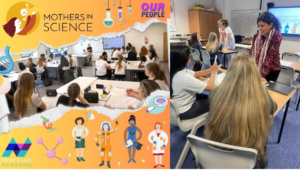
- Facilitated reflection and group discussion: Following the activity, a facilitated whole‑group discussion allowed students to reflect on the scenarios, share perspectives, and consider how their views related to those of their peers.
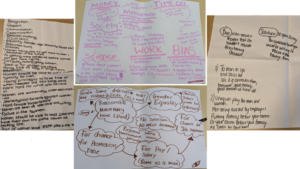
- Q&A with volunteer STEMM professionals who are mothers: Students took part in an interactive Q&A with volunteer STEMM professionals who are mothers, creating space for questions about careers, study choices, work–life balance, and experiences of motherhood in STEMM. This allowed students to engage directly with lived experiences and gain insight into varied career pathways and decision‑making processes.
- Post‑workshop survey (Qualtrics): The workshop concluded with a second Qualtrics activity, repeating and extending selected pre‑workshop questions to understand change in attitudes, awareness, and perceptions. Comparing pre‑ and post‑workshop responses enabled immediate evaluation of the workshop’s impact on student thinking around gender, STEMM careers, and motherhood.
The workshops were inclusive of students of all genders, recognising participants not only as potential future scientists, but also as peers, leaders, and employers within STEMM institutions. This ensured the workshop addressed how assumptions and expectations operate within STEMM environments, rather than focusing solely on individual experiences.
Evaluation and Evidence of Impact
Impact was evaluated using survey responses alongside qualitative insights from workshop activities and discussion.
- Pre- and post-workshop surveys to assess changes in students’ perceptions of STEMM careers and motherhood‑related bias
- Qualitative feedback from students and teachers collected through feedback forms and discussion
- Engagement metrics (including student attendance and interest generated, such as repeat invitations or referrals from schools)
- Digital analytics (views, shares, comments, website traffic)
- Long-term tracking via HEAT (with consent) to monitor educational progression into STEMM pathways
Key insights from staff and students
Feedback received from students showed increased awareness of structural barriers and greater confidence among students in envisioning STEMM careers.
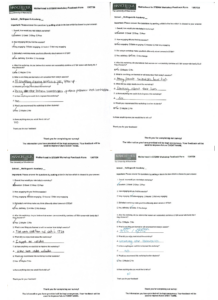
The workshop was also well received by participating schools, generating positive feedback from teaching staff and increasing demand for continued engagement and repeat delivery. For example, a teacher from Hollingworth Academy commented, “I found it a good opportunity to engage students in some careers they may not have before thought of, as well as starting some vital conversations regarding the struggles that mothers in science face. I feel it highlighted gaps in the students’ knowledge that I wasn’t aware of and has enthused me to teach them more regarding careers in STEM. I really enjoyed the aspects of the session that allowed students to discuss key aspects of mothers in science and an opportunity to share their experiences and goals. I’m really looking forward to repeating this with the next cohort of year 10s.”
This demonstrated both the perceived value of the workshop and demand for its continued delivery.
Conclusion and Implications for Educational Practice
This project highlights the importance of introducing structured discussion on the motherhood penalty, career sustainability, and structural inequality within educational practice. Students’ understandings of career pathways are shaped not only by formal education, but by broader societal narratives and expectations. Introducing such discussions at an early stage can play an important role in broadening students’ awareness of STEMM educational and career pathways and challenge gender stereotypes that may influence subject choices and aspirations. By exposing students to the experiences of women in STEMM and highlighting diverse career trajectories, these interventions may encourage more girls and young women to consider STEMM subjects and to progress into STEMM higher education and careers.
Importantly, while the project was delivered within a school context, its implications extend to higher education, where decisions about subject choice and university study are often shaped long before students apply. Supporting more inclusive perceptions of STEMM can therefore contribute to widening participation by strengthening the pipeline of students entering STEMM degree programmes, while also fostering a greater sense of belonging among those who do progress into higher education. Embedding these discussions within teaching and outreach supports a broader approach to widening participation that considers retention, progression, and identity, as well as access.
Acknowledgments
This work was funded by Faculty of Biology, Medicine and Health Access and Widening Participation Team, Mothers in Science and School of Biological Sciences Social Responsibility Team.
TEA is a place where we can share practice and experience around teaching and learning with colleagues, students and the wider public – how we Teach, Explore, Apply
We’d really like to hear your responses to the stories we feature – if you want to respond, please email the ITL team at teaching.learning@manchester.ac.uk, or the University’s Teaching and Learning Online Network (TALON) on Yammer is a great place for you to carry on the discussion of any practice you find really interesting.


Contact Us
+44 (0) 161 306 6000


0 Comments